
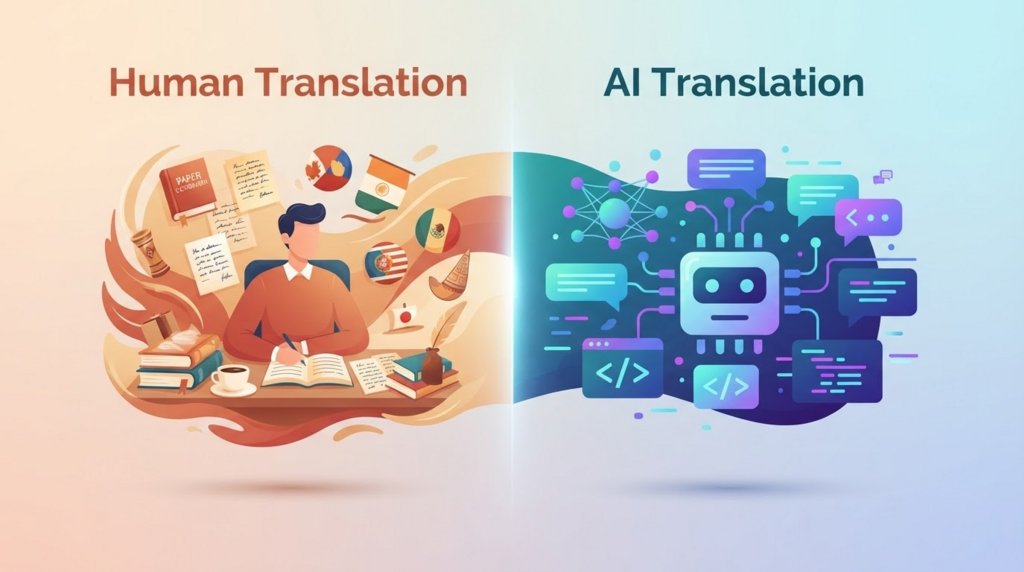
Research consistently finds AI translation is close to human quality for routine, high-resource text and clearly behind it for literary, legal, and low-resource work. One 2024 study rated GPT-4 as comparable to junior translators but behind mid and senior ones. In literary evaluation, annotators preferred human translations 86.7% to 95% of the time. The honest answer to “which is better” is that it depends on the language pair, the domain, and what happens if the translation is wrong. AI translation runs about 1 trillion words per month through Google Translate alone (Google, April 2026), which makes this a decision millions of people make daily by opening whichever app is on their phone.
I care about this for a personal reason. I grew up in Colombo, I live in Coimbatore, and I run SEOTamil.com and DigitalMarketingTamil.com alongside my English work. I have spent years moving the same ideas between Tamil and English. The gap between “technically correct” and “sounds like a person wrote it” is enormous. That gap is what this piece is about. Not a sales pitch. Not paid by any tool mentioned. What follows is what peer-reviewed studies and official documentation actually say.
How AI translation works, in one paragraph
Modern AI translation is neural machine translation with a transformer architecture underneath. An encoder converts source-language tokens into an embedding vector that captures meaning independent of the source words. A decoder generates target-language tokens one at a time, conditioning each choice on both the source embedding and everything it has produced so far. Training uses billions of parallel translation pairs scraped from official documents, subtitles, technical corpora, and web content. The system is not “translating word by word.” It is generating a plausible target-language sentence that means the same thing the source sentence appears to mean, based on the statistical patterns it saw during training.
Same core loop underneath GPT-based translation, Google Translate’s NMT, DeepL, and every other modern system. Architectural differences matter for edge cases; for routine translation, all top-tier systems now converge on similar quality.
The scale AI translation operates at
- 1 trillion words per month via Google Translate (Google, April 2026)
- 1 billion+ users active on Google Translate services
- 133 languages supported by Google Translate as of 2026 (about 250 dialects)
- ChatGPT and Claude offer translation as a byproduct of general-purpose language modelling and are widely used for it even though “translator” is not their headline feature
That is a staggering amount of language moving between humans with no human translator anywhere in the loop. The scale by itself does not settle the quality question. It does mean the answer to “does AI translation matter yet” is yes.
What human translation actually involves
Professional human translation is a formal process, not a bilingual person retyping text. Certified translators typically work through:
- Source-text analysis. Identifying register, audience, and any culturally-specific references.
- Terminology research. For technical, legal, medical, or specialised text, this can be half the work.
- First-draft translation. Producing a target-language version that captures meaning, not just words.
- Self-revision. The translator rereads against the source and rewrites for target-language naturalness.
- Independent revision. A second linguist reviews for accuracy, style, and terminology.
- Final proofreading. Grammar, spelling, punctuation, formatting.
The ISO 17100 standard formally requires steps 3, 5, and 6 for any translation calling itself “certified.” AI translation covers step 3 quickly. Steps 1, 2, 4, 5, and 6 either do not happen or happen by the user in a hurry.
The core differences at a glance
| Dimension | AI translation | Human translation |
|---|---|---|
| Speed | Seconds per page | Hours to days per page |
| Cost | Near-zero for consumer use | $0.10-$0.30 per word typical |
| Language coverage | 100+ languages in top systems | Depends on translator availability |
| Consistency | High within a document | High across a project (with translator memory) |
| Handling ambiguity | Often gets it wrong quietly | Flags for clarification |
| Cultural nuance | Weak | Strong |
| Legal / medical / literary quality | Insufficient without human review | Standard practice |
| Adaptation for target audience | None | Core skill |
| Errors | Confident, plausible, undetectable | Occasional, usually more visible |
How accurate is AI translation compared to human translation
The 2024 paper “GPT-4 vs Human Translators” (published in the Journal of Translation Studies) ran a controlled comparison across four language pairs (English-Chinese, English-Spanish, English-German, English-French) and three text types (news, technical documentation, marketing copy). The finding, roughly summarised:
- GPT-4 output was rated comparable to junior translators (0-2 years of professional experience).
- Behind mid-career translators (3-7 years).
- Substantially behind senior translators (8+ years).
The gap widened with:
- Literary or culturally-specific text. Idioms, wordplay, cultural references, and voice.
- Low-resource languages. Tamil, Bengali, Swahili, Vietnamese, and hundreds of others where training data is thinner.
- Legal or medical text. Where a single mistranslated term has real cost.
- Adaptation for a specific audience. Where “correct translation” and “right message” diverge.
The gap narrowed to near-zero for:
- News wire-style text. Simple, high-resource, formulaic.
- Product descriptions. Predictable structure, common vocabulary.
- Technical documentation between high-resource languages where terminology is stable and context is explicit.
Evaluation of literary translation
The literary case is more brutal. A 2024 study published in EMNLP evaluated four AI systems (GPT-4, Google Translate, DeepL, and Yandex) against human translators on 20 literary excerpts across five languages. Trained bilingual annotators picked the human translation as preferable 86.7% to 95% of the time, depending on the language pair.
The gap was not close.
Literature breaks machine translation because it uses:
- Voice and rhythm that emerge from specific word choices, not just meaning.
- Cultural allusions that a model without the human context misses or mistranslates.
- Wordplay and ambiguity that are the point, not obstacles to remove.
- Character voices that require consistency across chapters, not just sentences.
Human translators do not do this by accident. They spend hours per page choosing between options that carry the same meaning but different weight. AI translation converges to the highest-probability word, which is the opposite of what literary work needs.
The metrics you will see quoted
The measurement problem is real, and it changes the answer.
- BLEU (BiLingual Evaluation Understudy). Automatic score, 0-100. Compares AI output to reference translations by counting matching n-grams. Fast, cheap, and famously bad at capturing quality. A BLEU of 40 is very good on news text and mediocre on literature.
- METEOR, chrF, TER. Variants trying to fix BLEU’s blind spots. Better on some dimensions, still automatic-metric limited.
- COMET. Neural quality-estimation model. Correlates better with human judgement than BLEU. Still not the same as human judgement.
- Human evaluation. Trained annotators score for adequacy (does it mean the right thing?) and fluency (does it sound natural?). Gold standard. Slow and expensive.
The automatic metrics tend to overstate AI quality on news text and understate it on literature. The papers that use only BLEU produce different answers than the papers that use trained human annotators. When someone quotes a translation-quality number, ask what metric.
Where AI translation is genuinely good enough
Concrete cases where AI translation is fit for purpose, not just tolerated:
- Informal communication. Chat, casual email, social media, tourism.
- Reading comprehension of foreign-language text. You need to understand it, not publish it.
- Draft translation of high-resource business text with a human review pass afterwards.
- Internal documentation that a bilingual colleague can quickly sanity-check.
- Real-time voice translation for meetings and travel where “good enough” beats “no translation.”
- Content that will be reviewed by native speakers before publication.
The common pattern: AI as a first draft plus human as the checkpoint. That workflow beats either alone on speed, cost, and quality.
Where AI translation carries real risk
- Legal contracts, medical documentation, official filings. A mistranslation has cost or liability. Human translator only, or human translator plus AI first draft.
- Literary and creative work. AI produces flat text. Publishing it as-is damages the work and the writer.
- Low-resource languages. Training data is thin. Output can be confidently wrong in ways a bilingual human cannot easily verify.
- Culturally-sensitive or politically-charged text. Nuance goes missing in ways that produce real offence.
- Anything that will be publicly attributed to a named person or brand. The reputation risk sits on the human who signed off, not the model.
- Marketing copy for a new market. Translation alone is not localisation. Getting the message right for a new audience is a strategic exercise, not a linguistic one.
Is Google Translate the best translator
Google Translate is the most-used and, for many high-resource language pairs, competitive with the top alternatives. It is not always the best. DeepL is regularly rated higher for European language pairs (English-German, English-French, English-Spanish). GPT-4 and Claude match or exceed Google on complex text where context matters. Google leads on language coverage (133 languages), integration (Chrome, Android, Google Docs), and free-tier features (image translation, voice translation, conversation mode).
What Google Translate is genuinely best at:
- Language coverage. No other system supports as many languages at even usable quality.
- Image and camera translation. Point your camera at signage or a menu. Works.
- Voice input and conversation mode. For travel and real-time exchange, no serious alternative.
- Offline packs. Download a language pair, translate without internet. Useful in situations no other option handles.
Google Translate is not the best for literary quality, professional legal or medical translation, or nuanced marketing localisation. It was not designed for those cases.
Google Translate vs Apple Translate
Both are competent for the “read what this sign says” use case. Meaningful differences:
Google Translate. More languages (133+ vs Apple’s ~20). Better for less common language pairs. Camera translation is more mature. Conversation mode handles rapid back-and-forth better.
Apple Translate. Deeper OS integration (translate any selected text anywhere in iOS). Better privacy defaults (on-device translation for supported languages, no round trip to Apple servers). Cleaner UX for iOS users.
Which is better depends on which platform you already live in and how many languages you need. If your use case is “European or major Asian languages on an iPhone,” Apple. If your use case is “any language, any platform, most features,” Google.
The tools worth naming beyond Google
- DeepL. European-language leader. Higher literary and formal-register quality than Google for those pairs.
- GPT-4 / Claude. Best for context-heavy translation. Slower and more expensive per query.
- Amazon Translate, Microsoft Translator. Enterprise integrations, similar quality to Google.
- Reverso. Bilingual dictionary and context examples. Useful alongside another translator.
- iTranslate. Consumer app, decent for travel.
The tool that has the training data for your specific language pair usually wins for that pair. Test with the actual text you translate.
How to assess translation quality yourself
If you cannot commission a professional review, this is the assessment I run:
- Back-translate. Translate the output back into the source language with a different system. Compare against the original. Serious meaning gaps show up here.
- Native-speaker gut check. If you have any access to a native speaker, one paragraph of their read tells you more than any automatic metric.
- Domain-specific term audit. Pick the five most important technical or brand terms in the source. Check each in the translation manually.
- Register audit. Is the register formal / informal / academic where it needs to be?
- Consistency audit. Same concept translated the same way throughout, or drifting between synonyms.
Any translation that fails two of these five needs a human.
The hybrid model: machine translation post-editing
MTPE (Machine Translation Post-Editing) is what most professional translators actually do in 2026. The workflow:
- Run the source through a top-tier system for the first draft.
- Human translator revises for meaning, style, terminology, and cultural fit.
- Second human reviews.
MTPE cuts translation time by 30-60% versus from-scratch translation, at quality levels close to fully human. It also compresses the difference between junior and senior translators, because the first draft is already usable.
If your work needs professional-quality translation but not from-scratch pricing, MTPE is the mainstream option.
Will AI replace human translators
Not entirely, and not soon. The volume of “good enough” AI translation is exploding, and the volume of low-value professional translation is compressing. Simple documentation translation, straightforward business text, informal communication (huge markets by volume) are moving to AI plus light human review.
The market for genuine translation skill (literary, legal, medical, marketing localisation, low-resource languages, high-stakes communication) is holding steady or growing. Professional translators are increasingly working in MTPE, terminology management, and quality assurance rather than from-scratch translation. Same skill applied differently.
For the broader picture on which jobs get hollowed out and which do not, what jobs are safe from AI covers the framework.
Key papers if you want the primary sources
- Google, “20 Years of Google Translate” (April 2026, blog.google).
- 2024 paper “GPT-4 vs Human Translators: A Multi-Domain Evaluation” (Journal of Translation Studies).
- 2024 EMNLP paper on literary translation evaluation (86.7-95% human preference).
- ISO 17100:2015 standard for translation services.
The question is not which one wins. It is which one fits your specific text, language pair, and stakes. For high-volume, high-resource, low-stakes translation, AI is now the default. For anything where a mistranslation has real cost, humans still own the work. Everything in between belongs to the hybrid workflow.
Related Posts
78% of companies say they use AI. Only 21% redesigned a workflow. Here are the sourced AI adoption statistics and the ho...
A free, cited AI glossary covering 264 artificial intelligence, machine learning, and generative AI terms - plain-Englis...

I pulled 239 threads across 7 subreddits. Marketers use AI daily and hate the products. Here is what the highest-voted t...
The Chrome and Firefox extension I built to save, tag, version, and export AI prompts locally. Free. No account. No clou...
I ran a 26-feed pipeline for 34 days and logged 2,234 AI stories. Here are the sources worth your time by output, and 3 ...