

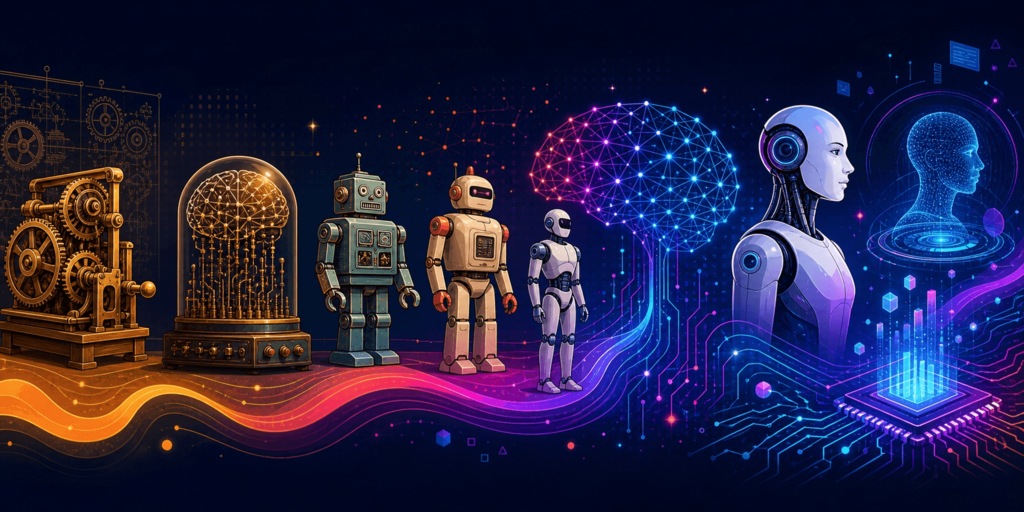
The history of AI starts in 1943 with the first mathematical model of an artificial neuron, gets its name at the 1956 Dartmouth workshop, and survives two funding collapses (AI winters, 1974-1980 and 1987-1993) before deep learning revives it in 2012. ChatGPT launched on 30 November 2022 and hit 100 million users in two months. The opponent this piece argues against is every AI history article that reads like a victory lap. The field has failed publicly, twice, hard enough that researchers stopped putting “artificial intelligence” on grant applications because the term had become poison. Knowing the actual history is the best defence against getting fooled by current hype, in either direction.
Who created AI and when
No single person created AI. The field was formally founded at the Dartmouth Summer Research Project in 1956, where John McCarthy coined the term artificial intelligence. The technical foundations were laid in 1943 by Warren McCulloch and Walter Pitts (first mathematical model of an artificial neuron), and in 1950 by Alan Turing (“Computing Machinery and Intelligence” and the Imitation Game). If you want one date for when AI was invented, use 1956. That is when the field got its name, its founding document, and its first generation of researchers in one room.
The room mattered. In 1955, John McCarthy, Marvin Minsky, Nathaniel Rochester (IBM), and Claude Shannon proposed the Dartmouth workshop on the claim that “every aspect of learning or any other feature of intelligence can in principle be so precisely described that a machine can be made to simulate it.” They asked the Rockefeller Foundation for $14,000. The foundation awarded roughly half. So the entire academic field of artificial intelligence was launched on about $7,000 and a two-page proposal.
Three names matter before 1956:
- McCulloch and Pitts (1943). Networks of simplified artificial neurons could compute logical functions. Every neural network running today traces back to that paper.
- Alan Turing (1950). “Computing Machinery and Intelligence” proposed the Imitation Game. Turing did not ask “can machines think?” He replaced it with a testable question: can a machine convince a human it is human?
- Frank Rosenblatt (1958). Built the Perceptron, the first trainable neural network. He is the reason “training a model” is a phrase that exists.
The complete AI timeline
| Year | Milestone | Why it mattered |
|---|---|---|
| 1943 | McCulloch and Pitts model the artificial neuron | First mathematical basis for neural networks |
| 1950 | Turing publishes “Computing Machinery and Intelligence” | Introduces the Turing Test |
| 1952 | Arthur Samuel’s checkers program | First program that improved through self-play |
| 1956 | Dartmouth Summer Research Project | The term artificial intelligence is coined |
| 1956 | Logic Theorist (Newell, Simon, Shaw) | Proved 38 of the first 52 theorems in Principia Mathematica |
| 1958 | Rosenblatt’s Perceptron | First trainable neural network |
| 1958 | McCarthy creates Lisp | The dominant AI language for 30 years |
| 1966 | ELIZA at MIT | First widely known chatbot |
| 1969 | Minsky and Papert publish Perceptrons | Exposed single-layer limits, chilled neural network research |
| 1972 | MYCIN begins at Stanford | Landmark medical expert system |
| 1973 | The Lighthill Report | Triggers collapse of UK AI funding |
| 1974-1980 | First AI winter | Funding and credibility collapse |
| 1980 | XCON deployed at Digital Equipment Corporation | Expert systems prove commercial value |
| 1982 | Japan launches the Fifth Generation project | Sparks a global AI funding race |
| 1986 | Backpropagation popularised (Rumelhart, Hinton, Williams) | Multi-layer networks become trainable |
| 1987-1993 | Second AI winter | Lisp machine market collapses, expert systems disappoint |
| 1997 | Deep Blue beats Garry Kasparov | First computer to beat a reigning world chess champion |
| 1997 | LSTM (Hochreiter, Schmidhuber) | Solved long-range memory in sequence models |
| 2009 | ImageNet released (Fei-Fei Li’s team) | 14M labelled images, the fuel for deep learning |
| 2011 | IBM Watson wins Jeopardy! | Natural-language question answering goes mainstream |
| 2012 | AlexNet wins ImageNet with 15.3% top-5 error | Starts the deep learning era |
| 2014 | Generative Adversarial Networks introduced | Breakthrough in generative modelling |
| 2016 | AlphaGo defeats Lee Sedol 4-1 | Landmark for reinforcement learning |
| 2017 | “Attention Is All You Need” introduces the Transformer | The architecture behind every modern LLM |
| 2018 | GPT-1 and BERT released | Pretraining becomes the default method |
| 2020 | GPT-3 ships with 175B parameters | Few-shot learning at scale |
| 2020 | AlphaFold 2 solves protein structure prediction | AI delivers a genuine scientific result |
| 2021 | DALL-E and GitHub Copilot | Generative images, AI pair programming |
| 2022 | Stable Diffusion open source | Open weights for image generation |
| 2022 | ChatGPT launches on 30 November | 100M users in two months |
| 2023 | GPT-4, Claude, Bard, Llama 2 | The frontier model race begins |
| 2024 | o1 reasoning models, EU AI Act, Nobel Prizes for AI | Reasoning, regulation, recognition |
| 2025 | DeepSeek R1, GPT-5, Gemini 3 | Open reasoning models close the gap |
| 2026 | GPT-5.5, Claude Opus 4.8, Claude Fable 5 | Release cycles compress to weeks |
The table is the short version. The interesting part is what happened between the rows.
1943-1955: foundations before AI had a name
Three papers set the stage. McCulloch and Pitts (1943) proved artificial neurons could compute logic. Turing (1950) turned “can machines think” into a testable game. Arthur Samuel (1952) wrote a checkers program that improved through self-play, giving us the first machine-learning program in the modern sense.
Cybernetics was the parent discipline. Norbert Wiener’s book of that name and the Macy Conferences (1946-1953) provided the theoretical vocabulary the Dartmouth founders would inherit.
1956-1973: the golden age and the first big promises
The Dartmouth workshop produced the field’s founding cohort. Between them they built the Logic Theorist (Newell, Simon, Shaw, 1956, proved 38 of the first 52 theorems in Principia Mathematica), Lisp (McCarthy, 1958), the Perceptron (Rosenblatt, 1958), and ELIZA (Weizenbaum, 1966, the first widely-known chatbot).
The promises were larger than the results. Simon predicted in 1965 that “machines will be capable, within twenty years, of doing any work a man can do.” Minsky predicted in 1970 that in “three to eight years we will have a machine with the general intelligence of an average human being.” Neither came true. Both statements aged badly enough to help fund the coming winter.
The 1969 turning point was Perceptrons by Minsky and Papert. The book showed a single-layer perceptron could not learn the XOR function, and its influence chilled neural network research for the next 15 years. The math was correct. The framing (that this was a fundamental limit rather than a solvable engineering problem) turned out to be wrong. Multi-layer networks with backpropagation would solve it. That took until 1986.
1974-1980: the first AI winter
The 1973 Lighthill Report to the UK Science Research Council concluded that AI research had failed to deliver on its promises. UK funding was cut sharply. DARPA followed in the US, redirecting money away from open-ended AI research. Labs closed. Careers ended. Researchers stopped using “artificial intelligence” on grant applications because the term had become poison.
The technical reasons for the collapse were real. Computers were too small (a 1970s mainframe had less memory than a modern USB stick). Training data did not exist at scale. The symbolic AI programs of the era brittle-failed on edge cases nobody had anticipated. The promises had outrun the hardware, the data, and the algorithms all at once.
1980-1987: expert systems and the second boom
XCON, deployed at Digital Equipment Corporation in 1980, saved the company roughly $40 million a year configuring VAX minicomputers. That commercial win kicked off the expert systems era. Japan’s Fifth Generation project (1982) committed $850 million to build a national AI infrastructure and sparked a global funding race. Backpropagation, though invented decades earlier, was popularised by Rumelhart, Hinton, and Williams in 1986 and made multi-layer networks trainable.
1987-1993: the second AI winter
Expert systems turned out to be expensive to maintain, brittle at the edges, and unable to generalise. The specialised Lisp machine hardware market collapsed as cheaper Unix workstations from Sun caught up. Japan’s Fifth Generation project ended without delivering its promised intelligent machines. AI was a poison term on grant applications again. Companies that had built entire businesses around expert systems shut down or pivoted.
Two things kept the field alive through this decade: quiet academic work on machine learning (statistical methods, neural networks that would not be publicly celebrated until 2012), and rebranding. What used to be called AI became “machine learning,” “pattern recognition,” or “informatics.” Same math. Different marketing.
1993-2011: quiet progress and public wins
Deep Blue beat Garry Kasparov in 1997, ending the “computer can never beat a reigning world chess champion” era. LSTM (Hochreiter, Schmidhuber, 1997) solved the vanishing-gradient problem that had blocked long-range memory in sequence models. IBM Watson won Jeopardy! in 2011.
The boring milestone that mattered most: ImageNet. Fei-Fei Li’s team released the ImageNet database in 2009: 14 million labelled images across 20,000 categories. It is not a model or an algorithm. It is a dataset. It became the fuel that made the deep learning revolution possible three years later.
2012-2017: the deep learning revolution
AlexNet won the 2012 ImageNet competition with a 15.3% top-5 error rate. The next-best entry sat at 26.2%. That gap was the moment deep learning became the default approach to computer vision, and shortly after, to nearly everything else.
Between 2012 and 2017: Generative Adversarial Networks (Goodfellow, 2014). AlphaGo beat Lee Sedol 4-1 (2016). “Attention Is All You Need” (Vaswani et al., 2017) introduced the Transformer architecture that every modern LLM inherits.
2018-2022: the language model era
Pretraining became the default. GPT-1 and BERT (2018) showed that a model pretrained on a large corpus could be fine-tuned to many downstream tasks. GPT-3 (2020) at 175B parameters made few-shot learning at scale a serious research direction. AlphaFold 2 (2020) delivered a genuine scientific result: predicting protein structures at near-experimental accuracy.
Generative AI arrived in force in 2021-2022. DALL-E and GitHub Copilot (2021). Stable Diffusion open-sourced (2022).
30 November 2022: ChatGPT launched. Reached 100 million users in two months. Fastest consumer product adoption in history. The public conversation about AI changed permanently that week.
2023-2026: the mainstream AI era
2023. GPT-4, Claude, Bard, Llama 2. The frontier model race opened. Every major tech company committed to shipping foundation models.
2024. o1 reasoning models introduced explicit chain-of-thought at inference. The EU AI Act passed. Nobel Prizes in Chemistry (Hassabis, Jumper, Baker for AlphaFold) and Physics (Hopfield, Hinton for neural networks) went to AI researchers, a first for the field.
2025. DeepSeek R1 shipped a competitive reasoning model at a small fraction of frontier compute cost. GPT-5 and Gemini 3 pushed the frontier again. Open-weight models closed the gap on hosted APIs meaningfully.
2026. Release cycles compressed to weeks. GPT-5.5, Claude Opus 4.8, Claude Fable 5 all shipped in the first eight months. My pipeline logs 66 unique AI stories a day. When the news volume gets that heavy, the pattern from the two winters is easy to forget.
What 80 years of history actually teaches
The recurring pattern: hardware, data, and algorithms have to be ready at the same time for a breakthrough to stick. Neural networks were invented in 1943. They failed to become dominant until 2012, because ImageNet (data), NVIDIA GPUs (hardware), and refined backprop (algorithms) had to line up. Transformers were invented in 2017. They took five years to reach mainstream users because inference cost had to fall far enough for a chat product to be viable.
Second lesson: every AI boom has overpromised on timelines. 1965: “any work a man can do” in 20 years. 1970: “general intelligence of an average human being” in three to eight. 2015: “self-driving cars in five years.” Timelines are consistently wrong. The technology usually arrives. The dates almost never do.
Third lesson: winters are not the death of a field. They are the periods when the vocabulary changes and the useful work continues under different names. The people who kept doing gradient descent through the second winter of 1987-1993 were the ones who won when the field returned.
Is 2026 another bubble? The pattern says the honest answer is “some parts of it, yes.” Model capability has advanced faster than product-market fit has. Commercial value is concentrating around a small number of hyperscalers. Enterprise adoption is high, transformation is low. History suggests the technology will consolidate to what actually works, some of the current valuations will not survive the consolidation, and the underlying capabilities will keep improving through and past whatever pullback comes.
For the current-adoption picture behind those observations, AI adoption statistics covers the receipts. For live news volume, best AI news sites covers the pipeline data. For the vocabulary the timeline uses, the AI glossary has plain-English definitions for 264 terms.
Related Posts
78% of companies say they use AI. Only 21% redesigned a workflow. Here are the sourced AI adoption statistics and the ho...
A free, cited AI glossary covering 264 artificial intelligence, machine learning, and generative AI terms - plain-Englis...

I pulled 239 threads across 7 subreddits. Marketers use AI daily and hate the products. Here is what the highest-voted t...
The Chrome and Firefox extension I built to save, tag, version, and export AI prompts locally. Free. No account. No clou...

I ran a 26-feed pipeline for 34 days and logged 2,234 AI stories. Here are the sources worth your time by output, and 3 ...